Day 9 - Haunted by the Holidays: Giving Voice to the Ghost of What Could Have Been

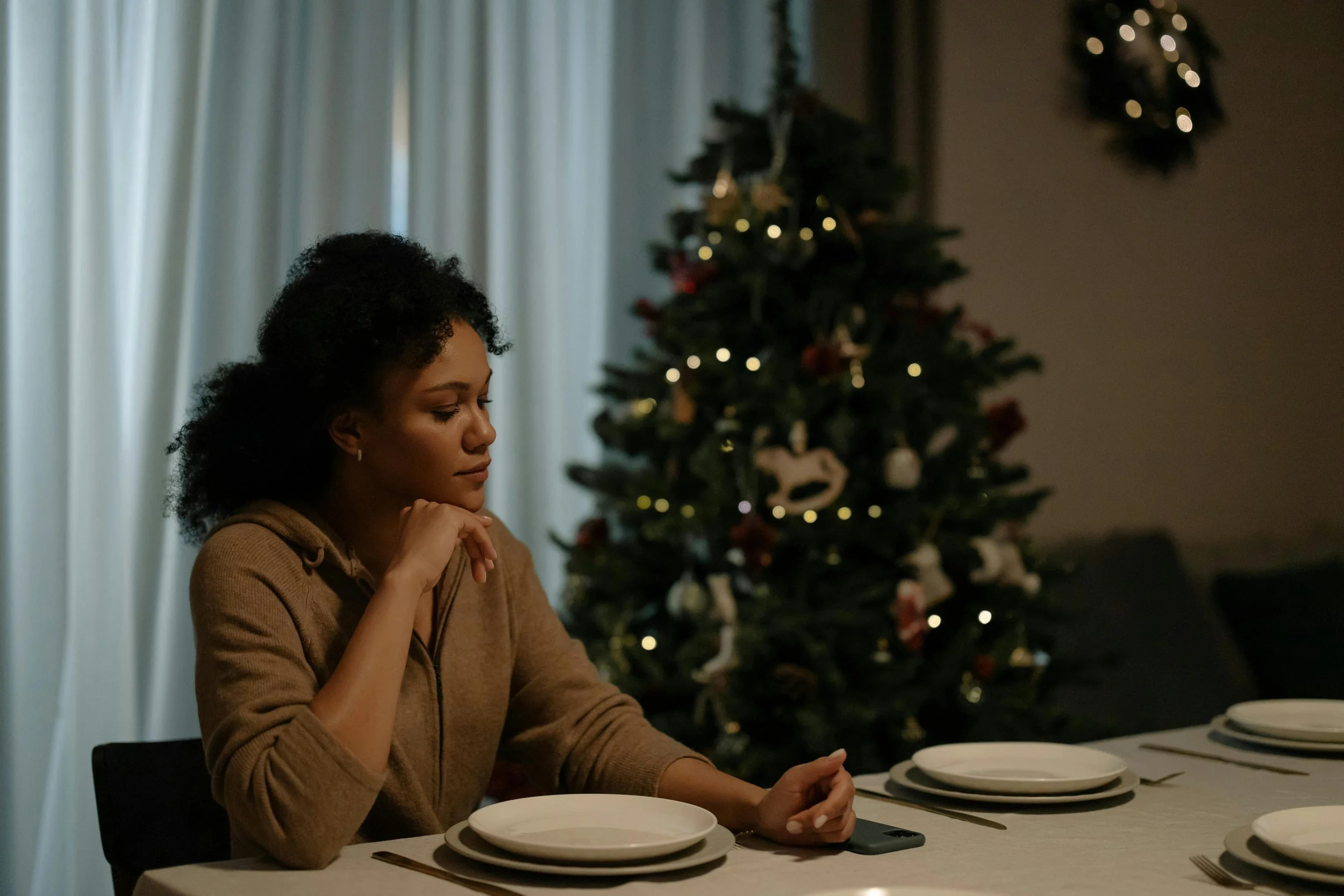
Let's talk about the ghost around the Christmas dinner table. Not the ones in A Christmas Carol, but the one you carry in your heart. It's the haunting feeling that hits when you see a genuinely sweet family moment in a movie, or when you drive past a house with warm, glowing windows and feel a pang of something that isn't quite envy. It's the grief for the holidays you were promised, sold, maybe even spiritually guaranteed... but never actually got to experience.
This isn't about missing a specific person or a tradition that ended. This is ambiguous grief.
It's mourning the absence of something that never was. The absence of safety, of ease, of feeling genuinely wanted and relaxed in your own family. It feels disenfranchising because how the hell do you explain that you're heartbroken over something that never existed in the first place? You're not just crying over spilled eggnog. You're crying over the fact that your cup was always empty.
The Hallmark Hangover: When the Fantasy Highlights the Absence
Starting November 1st we're fed a non-stop, steady diet of holiday fantasy. The movies where a single heartfelt speech melts decades of ice. The commercials where multigenerational families laugh effortlessly over a perfect honey baked ham. It's the cultural equivalent of being shown a gourmet feast while you're being handed a stale cracker and told to be grateful.
So when you finally make a healthy choice for yourself, like setting a boundary or creating distance, this grief can swoop in like the Ghost of Christmas Past. It doesn't mean your choice was wrong. It means your body and heart are finally safe enough to feel the full weight of what was missing. You've stopped bracing for the next blow, and in that quiet, all the old longing whispers,
"But what if it could have been different?"
That whisper isn't a sign you should reverse course. It's a sign you're human.
You can absolutely miss the idea of a warm, loving family while knowing the reality of yours is harmful. Both are true. Holding that "both" is the advanced work.
Why Grief Shows Up After You Set the Boundary (It's Not a Setback)
Think of it like this. For years, you were living in a cold room. Your job was just to stay upright, and not freeze to death. You were in survival mode, and numbness was your friend.
Then, you finally build yourself a safe, warm house (your boundary). You step inside, close the door, and for the first time, you start to thaw out. And as you thaw, you begin to feel the full, aching extent of how cold you actually were. The grief that floods in isn't about the warm house being a mistake. The grief is the thaw. It's proof you're now in a safe enough space to finally feel the old injury.
You are not regressing. You are feeling, for the first time, the true cost of what you survived. That is a brutal and sacred part of healing.

How to Hold What's "Missing" Without Abandoning Yourself
This grief is tender. The goal isn't to fix it, talk yourself out of it or make it go away. The goal is to give it a dignified place to sit so it doesn't run the show.
Name the Specific Ghost. Get granular. Don't just say "I'm sad." Say, "I'm grieving the fact that no one ever asked me what I wanted for Christmas." Or, "I'm grieving the fact that laughter in my house felt dangerous, not joyful." Or, "I'm grieving the fact that I never had a parent who was curious about me." Naming it gives it a voice, for you to witness, and gives you clarity, so you don't feel consumed by it.
Create a Small, Kind Ritual. This is an opportunity to acknowledge the loss, without having to recreate the family. Light a candle for the childhood wonder you lost. Listen to one song that resonates with what you're feeling. Write the loss down on a piece of paper and literally put it to rest (bury it, burn it safely, float it away). You are the loving witness your younger self never had.
Let it Be a Both/And. Practice the sentence: "I am so sad about what I didn't get, and I am so proud of myself for building what I have now." Your sadness does not cancel out your strength. Let them coexist in the same body. You are complex enough to hold both.
Beware the Nostalgia Trap. Your brain might try to romanticize the past, editing out the screaming fights and focusing on the one time you got a present you liked. This is a neurological trick, not truth. Grieve the good moments you did have while holding firmly to the reality of why you needed boundaries. Don't let a wistful memory trick you into re entering a warzone.
Your grief is not a problem to be solved. It is a testament to your heart's capacity to know what love should have felt like. That knowing is what guided you to make healthier choices. You can miss the dream and still choose your reality.

Your Next Step (If You Want One)
Navigating this kind of formless, complex grief is lonely, courageous work. It requires a space where your sadness is welcome without anyone rushing to fix it, rationalize it, or shove it back in a box so the holidays can be "merry and bright."
In my practice, we make room for the ghost. We learn to sit with the absence without fear, understanding that this grief is not a sign of failure, but a sign of your profound depth. We build a relationship with all parts of your story, especially the ones that hurt.
If you're tired of carrying this ghost alone and are ready to honor your past without being haunted by it, let's talk. I offer free 20 minute consultations to see if this work is your next right step.
Click here to schedule your consult. You deserve to make peace with every part of your story.